[00:00:00] Welcome back to Own Your Impact. I'm Macy Robison. Now, I want to name something today that I think almost everybody believes, usually without examining it, and then I wanna take it apart. And this applies to you whether you are looking to invest in a program to develop yourself further, or if you're contemplating how you're going to share and commercialize your offers and your intellectual property.
I think it applies to both sides. But here's the belief: one-on-one is the premium option only, and a group is the discount version. I think all of us have absorbed this. One-on-one is the expensive tier, it's the bespoke, it's the VIP, it's the real thing, and a group program is what you do if you can't afford the real thing, or maybe if on the offer side, it's what you offer when you wanna make more money for less of your time, and that feels like it's a little bit less impressive or important.
More attention for a [00:01:00] one-on-one, that's better. Group is less attention. That's worse. And a group means you're sharing the coach, you're getting a thinner slice. And I get it, like I understand why this belief exists. I have had this belief and been challenged on it recently, which is why I wanna talk about it.
I think for some kinds of work, One-on-one is the better option for specific situations. If I have specific narrow technical problem and I need an expert to co-create to solve it with me, one-on-one is exactly right. Just two people, full attention, focusing on my exact situations But after watching a lot of thought leaders develop programs and working on shifting and developing my own commercialization offers, I am beginning to believe that for the work of becoming a thought leader, that belief is incomplete.
A group is not the discount version of what I specifically offer or what other people might offer. For some people, I think for a lot of people, a group might [00:02:00] be the better version because it's the more accurate one. And so that's what I wanna spend this episode talking about. Because if you've been waiting to invest in one-on-one help before taking your own work seriously, or if you've been hesitant about offering something in a group format, you might have been waiting for the wrong thing.
And so here's the question that kind of unlocked all of this for me: What are you actually building? For me, I'm helping people become a more resonant version of themselves as a thought leader, to create a signal that cuts through the noise, that doesn't compete with, with all of the volume that's out there, but feels like the source that they are, the clear signal that they're sending out, and they can send out again and again and again to help people resonate and move.
And so if I'm helping people become a thought leader, they're building a body of work that goes out to rooms, to audiences, to individuals in those rooms, and individuals in groups of [00:03:00] people. But I don't give a keynote to one person, I give it to a group of people. .. While I write a book that will be read by one person, I have to market it to thousands of people and speak about it to thousands of people that I might never see in person.
I- they might hear me on a podcast. A workshop or a course or a framework or a message, all of those things, they're built to land with one person and many people at once. So a thought leader doesn't just build for one person, a thought leader builds for a room. So if I have to hold that next to the way most people try to develop and the way I've actually been positioning my offers, trying to develop thought leadership one-on-one, just them and a coach.
And I think in a lot of different types of offers and expertise, there's a mismatch hiding there that people might not notice you're trying to build something for a broad audience, [00:04:00] an audience that you're trying to invite in to work with you, but you're practicing in a one-on-one container with one person.
So when I put this in music language, it made a little bit more sense, so I'm gonna do the same. A one-on-one coaching relationship is like a voice lesson, and I want to be clear, voice lessons are wonderful. I have taken them my whole life. In a voice lesson, it's you and the teacher, and they know your voice, and they can hear every detail.
They can stop you on a single note. They can calibrate to you and only you. It's precise, it's deep, and there is real, genuine, true work that can only happen there. But here's what a voice lesson is not. A voice lesson is not a performance. There is no audience. The acoustics of that little room, that little studio where you take your voice lessons are not the acoustics of a concert hall.
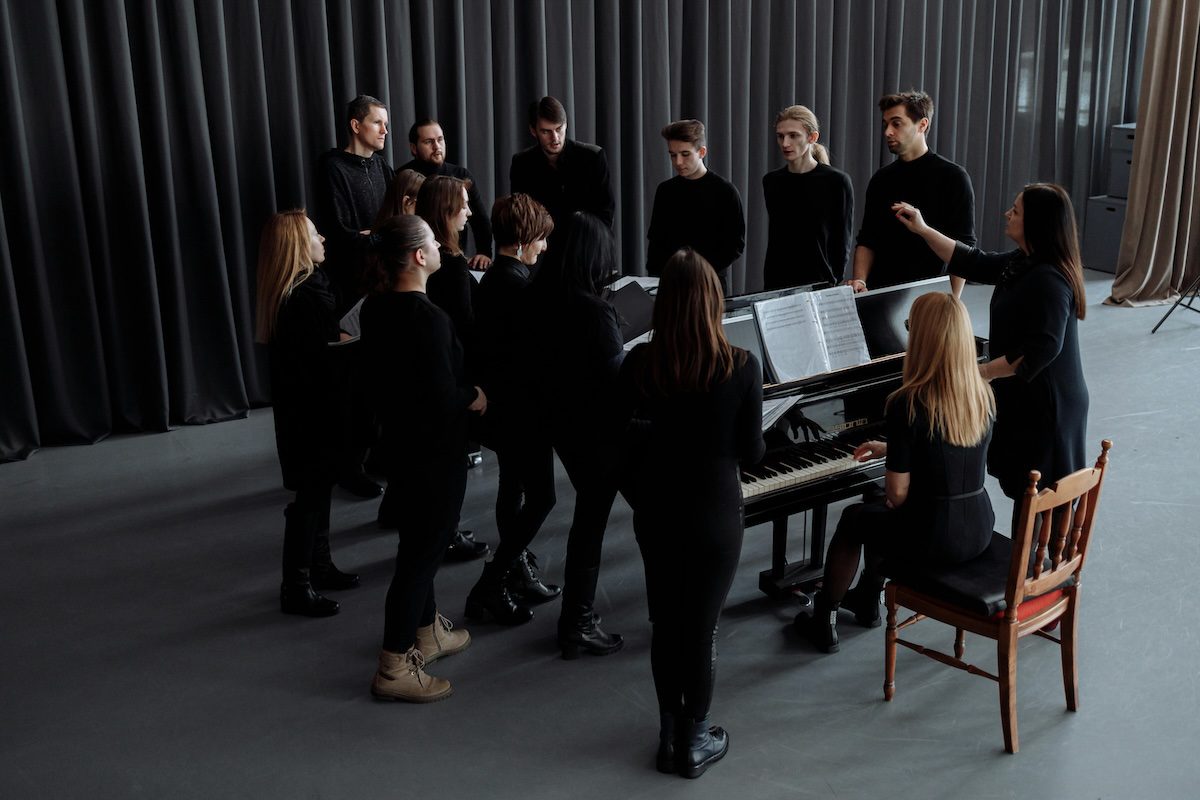
Nobody is sitting in the audience receiving what you send. The voice lesson does develop the instrument, but it doesn't [00:05:00] rehearse the performance But there's another way, a masterclass. It's a both/and. I studied music in college. If you've never seen a masterclass or know what that is, a masterclass is a format from music theater world, anywhere where there's performance involved.
There's a master teacher, a group of performers, and the performers take turns performing for one another. Usually, it's aligned with your voice teacher or your percussion teacher or your piano teacher. You take your private lesson, and then in a masterclass, one person gets up and performs, and the teacher coaches them right there in front of everyone, gives them feedback.
The students in the room can also , give feedback, and then the next person gets up and performs. And here's the thing everyone discovers at a masterclass. When you're the one being coached, it's valuable. It's a forcing function. It gets you on your feet, and it makes you practice. It gets you ready.
But I think the thing most people don't expect is you can learn just as much and sometimes [00:06:00] even more by watching the master coach somebody else. Because when the teacher's working with a performer before you or after you, you aren't just watching. You're hearing an issue that you also have, and it's named out loud in someone else's voice.
You're watching a fix that you needed , being demonstrated on someone who isn't you, which means you can actually see it clearly instead of being in the middle of it. You're calibrating a lot of different ways because you're hearing five different singers, and you're starting to understand what your own voice is in contrast with theirs.
I loved my masterclasses in college for that reason. And when you're in a masterclass, you're doing the thing that a one-on-one lesson can't give you. You're performing in front of people. You're feeling what it feels like to send your signal out to actual people and have it either land or not land, and you figure out how to adjust.
Masterclasses are not discount voice lessons. It's a different thing. The master classroom [00:07:00] actually resembles the stage, and I think that's what a good group program can do. And for thought leadership specifically, the group is not the lesser version, it's the truer one. Hopefully, we can combine it so it's one-on-one and group.
So let me get specific about what group gives you that one-on-one structurally can't. Three things. The first thing is contrast. Contrast is not a nice-to-have, it's how you actually see yourself. I've talked about this on the podcast before. You can't see your own distinctiveness and uniqueness in isolation.
Your wiring, the way you're built, it feels normal to you. It feels like air. It feels like a fish swimming in water that it doesn't know is there. It feels like how things are. But the only way you can see it clearly is next to someone that's built differently from you. In a one-on-one container, you have one point of reference: your coach.
They're the ones who you are looking to for a reaction, for a response, for learning, for recognition. And in a [00:08:00] group, you have a whole room full of people. You watch someone whose ideas come alive in writing express , what they have to share, and then you realize, "Well, mine, mine come alive when I say them out loud."
And suddenly, you understand your own wiring in a way that you never would have. Or even better, two sopranos, like in a voice lesson, when they hear one another sing the same song, they learn something about themselves and how their own voice is unique. Two wisdom writers in the same group might learn something about their specific writing style and their specific archetype that helps them dial into their own signal that they're sending out a little bit better
All of that becomes visible by contrast. Contrast helps you see. The group is a room full of mirrors. A one-on-one is one single mirror, and you can see more of yourself and all sides of you with more mirrors in the room. The second thing a group can give you is real conditions, the actual acoustics of sharing your ideas out there.
If you're going to put them out into the world, [00:09:00] ideas out into the world, you need to learn what it feels like to do that, to say the thing you actually believe out loud to a room full of people who did not have to agree with you and watch what happens. To feel a moment land or to feel a moment not land and survive and stay standing anyway.
You can't rehearse that by yourself into a hairbrush, into the mirror, or one-on-one in a voice lesson. One-on-one is a conversation with one safe person. The group is the first real room. It's where you find out your signal can go out to people who are not your coach, not your voice teacher, and still carry, and that is not a small thing.
Because for a lot of people, that's the fear that keeps them back, and a group is where that fear gets metabolized and becomes useful because you face the smaller version of it Before you face the bigger one. The third thing a group gives you is the part that it's really hard to put on the sales page, and I think it's the most valuable.
I think a group is where the work actually happens. In my case, when someone's in a room [00:10:00] of people all developing their thought leadership at the same time, their idea doesn't just get my response, it gets the whole room's response. Someone might ask a question that I wouldn't have thought to ask because they're wired differently than I am.
I see that happen every day. Someone else hears your half-formed idea and reflects back a piece of it you couldn't see. Your signal goes out, and it comes back with data points from eight different people instead of just one. A one-on-one gives you one set of ears, and even if they're really great, highly trained, calibrated ears, a group gives you a whole room full, and I think that helps you pick up velocity because there's more signal coming back.
There's more data, and data helps you make more confident decisions. Now, I don't want this to sound like I'm dismissing one-on-one work. I am not. I include it in all of my group containers, me personally. Here's the real distinction, and it matters. One-on-one work is the right tool when your work is genuinely about your single specific situation, and you need [00:11:00] depth on that and nothing else.
It's really the work of calibration. It is the voice lesson. Sometimes you just need a voice lesson. And in my case, very established thought leaders, someone already out there, already performing, who hits a very specific growth edge in their work and needs calibration, I work with them one-on-one
If someone is just starting out and they're calibrating their resonance compass for the first time, that's a one-on-one conversation, and that's included in the group containers that I create. But most people aren't at that calibration stage. Most people are at the development stage. They're still building their body of work.
They're still figuring out what it feels like to send out the signal. And for that, the group is not the compromise. It's exactly the right room. It's the masterclass and the voice lesson. You would never learn to perform on stage by only taking private lessons and never getting on a stage. And you don't become a thought leader, someone who has great thoughts and people following [00:12:00] them, by only ever developing in private and never being in a room.
There's one more thing to clear up, and I think it's the fear that keeps people choosing one-on-one to either offer or invest in when the group might be the right decision. And the fear is this: If I'm in a group, I'm gonna get something generic, something that's self-serve, something that's a template or one size fits all, and I won't get something that fits me.
But I wanna take that apart because it comes from mixing up two words: customized and personalized. Customized means built from scratch every time, bespoke, every person, nothing shared, blank page for each individual. That is really rare work, and it's important. Customization is good, and it matters, but it's not required 100% of the time.
I think personalized work is. That means there's a shared structure, and it gets calibrated to you. It's, it's the difference between getting a bespoke garment created for you [00:13:00] and something that you buy off the rack that you then take the time and care to tailor to you so it feels like yours. Or to bring back my voice lesson analogy again, my daughter and I take voice lessons together.
We split an hour with our teacher's time. We are decades apart in age. We have completely different voices and completely different goals. So the structure of the lessons you would think would be different, and the outcome, what you hear if you were just listening to both of us, would feel different, but the underlying structure is exactly the same.
Our teacher warms us up, we talk about what needs to be worked on, and then we work on applying it to songs. Our teacher does not invent a brand-new art form from nothing every time someone walks in their studio. The structure is shared. It's the same. And inside that structure, she is able to completely personalize to our actual voices as she works with us.
And I think that's what a well-built program does. [00:14:00] The structure is shared, and what makes it trustworthy and makes it teachable is what gives you the opportunity to personalize, and having IP and a framework for people to work with is what does that. It... You can personalize it then to your wiring, to your archetype, to the specific thing you're building.
A group isn't a customized experience, and it shouldn't be, but a good group is deeply personalized. And if it's personalized inside a shared structure in a room full of other people that learn from the contrast that you see, I don't think it's less than customized and alone. And I think, and like I said, I've been challenged on this lately.
I think it actually is the better thing. So here's what I wanna leave you with. If part of you has been waiting, waiting till you can afford one-on-one help, waiting for a VIP or premium tier before you take yourself seriously and your thought leadership seriously, I think you might have been waiting for the wrong room.
One-on-one is not the graduation of this work. [00:15:00] I think the room is. A group program is where you can see yourself by contrast, where your clients can see themselves by contrast. It's where you can feel your signal land on real people and give your clients the gift of that signal landing on real people.
It's where work can develop faster because it's coming back to you from lots of different directions. That's not a budget option. That's the rehearsal that actually looks like the performance, and that is very valuable
So whether you're looking to invest in something and you're unsure if group is worth it, or you're looking at your own commercialization structure and you're wondering if you're copping out by offering a group program, I want you to rethink it Regardless, here's the first step. Before you step into any room, you need to know a lot about the intr- instrument you're bringing to it.
You can't have a voice lesson inside a studio full of tuba students. So you have to know how you're wired, and that's what the archetype assessment is for. It's free. It's at [00:16:00] macyrobison.com/quiz, and it gets you started calibrating your own unique resonance compass and how you express yourself, and that's how you start in the room.
You can't do well without it. And when you're ready, in my case, for the room where you can build this, that's what the Resonant Thought Leader Conservatory is for. It's a group on purpose, not because it's easier for me to run, but because it's the master class version. You get one-on-one time with me, you get group time with me, and you get to develop in that together.
If you want to learn more about that, please reach out. Or the fastest way to learn more is to come to one of my weekly Find Your Frequency workshops. We spend real time in that Find Your Frequency workshop, helping you see how your archetype assessment applies and is personalized to you. And at the end of that conversation, if it's the right fit for you to come into the conservatory, I issue you an invitation.
If it's not the right fit, I'll let you know. But if that's a room you [00:17:00] wanna be in, taking the assessment, coming to the workshop, those are the next two steps. Your ideas matter. The way you containerize them matters. The way you engage with developing new ideas matters because your expertise has value to share with others, and investing in it matters.
It was always built to go out to rooms. So at some point
Thinking of what you're actually building, what you're actually working toward, and creating the conditions that give you a chance to practice that in a safe way is the next critical step. And I hope as you're thinking about what you're building and offering to others and what you're trying to do while building and investing in yourself, you take that into consideration.
We'll see you next week








+ show Comments
- Hide Comments
add a comment