77_The Content Drawer: Collect Before You Curate
===
[00:00:00] I want to start off today with a question. How many of you have a junk drawer in your house? Now, I'm not trying to insinuate you have a messy house. I'm fairly confident that every one of you listening has the thing I'm talking about, even if you use a different name.
I'm talking about that one specific drawer in your kitchen, in your office, maybe both, that everybody in the family knows about and no one has ever labeled or fully organized. Okay, so you probably have one. Second question, this one's a little bit more vulnerable, how many of you have ever opened that drawer, that junk drawer, in front of a complete stranger?
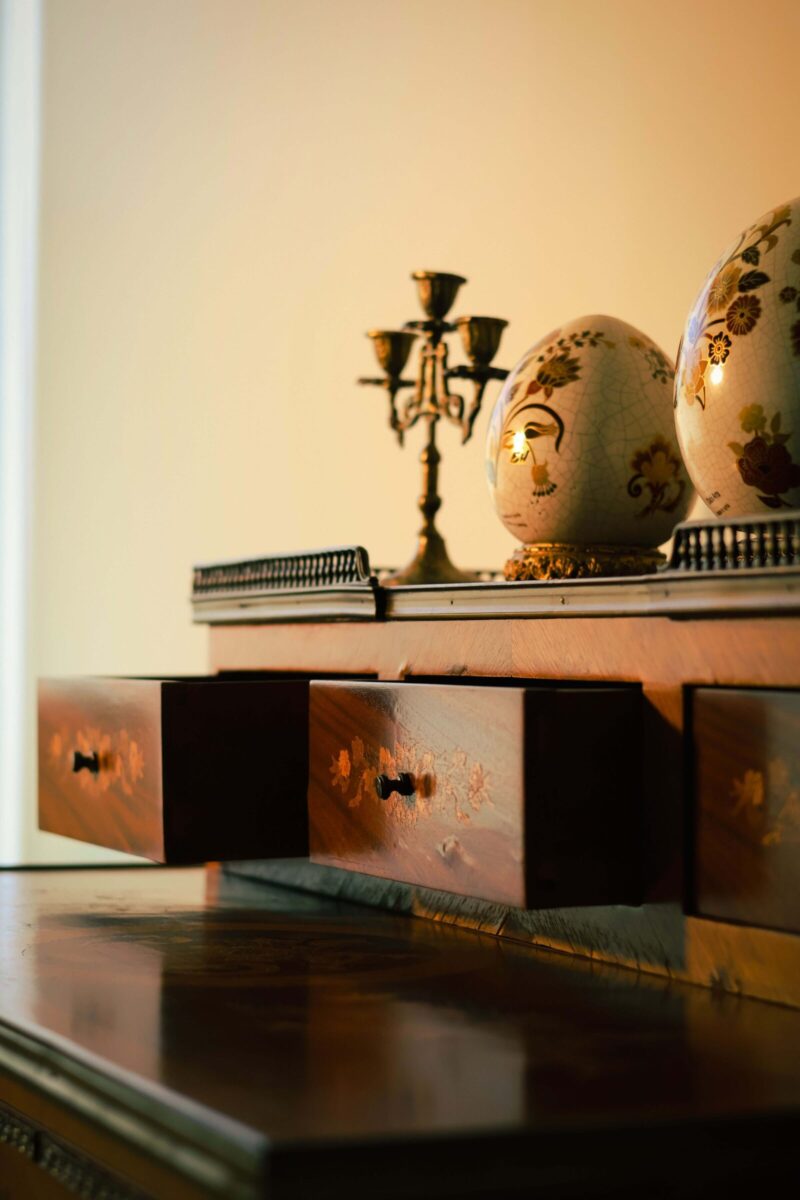
I'm not looking for accolades here, but I have been doing exactly that quite a bit over the past couple of weeks on client calls on purpose. I have started just pulling that specific drawer open in my office, it's the second drawer down, and letting people see what's in it. Because a connection I made recently that I've not been able to stop thinking about has to do with that junk drawer, and it turns out the fastest way to explain this concept is just to show s- show folks what's inside.
[00:01:00] So even though we're on audio, I'm gonna go ahead and open up my drawer right now and tell you what I've got inside this desk drawer. It's always a surprise to see what's there, so I kind of don't remember what's in it, um, which is kind of the point. There's things that are buried. Okay, here's a new thing.
A pin from Grand Nationals Marching Band Competition in Indianapolis, 2022. Okay, not even my son's senior year. That ... My son was in the American Fork Marching Band. They marched back there in 2022, as well as in, I believe, 2024, but that's the old one. Great. Okay. There's a crystal someone gave me. I don't know what it means or why it's there, but it felt important at the time.
My favorite, and I showed some folks this the other day, I have these really cool Bruno Mars and Hello Kitty stickers that I waited in a very long line to get when we went and saw Bruno Mars earlier this summer. Um, some Post-It flags. Uh, my client Luvvie's Professional [00:02:00] Troublemaker pin from that book launch several years ago, and then another pin, um, from my friend Ronnie.
She has a book coming out this fall called Work Life Remix, and it's the coolest little briefcase mix tape pin. Um, this is a fun one. JJ Peterson, my friend. Um, JJ's Badass Softie podcast stickers. There's a bracelet, some lip balm. This is my favorite one I found the other day, a Disneyland badge that our old neighbor gave us because she and my daughter have the same first name and they both love Disney, and she worked there, and she gave it to me.
My daughter didn't want it, and I took it, put it in this drawer. So when you pull all of that out and you look at it and we talk about it here on the podcast or I show someone on a call, it looks like a bunch of random stuff, but it's not random, and I think this is the thing that most people miss about junk drawers like this.
Every single object in this drawer is here for the same reason. One... Well, two reasons. First reason, it mattered to me. I cared about [00:03:00] this thing. But the second reason is I didn't know where it should live. It didn't have a home. I didn't have a place to store it. And that's it. That's the whole admission policy to get inside that junk drawer.
I didn't wanna lose that Disneyland badge, but I don't know where to put it, so it went in the drawer. That marching band pin is not gonna go in the really cool shadow box I'm planning to make for my son now that he's been out of high school for a full year anytime soon, but I'm not throwing it away, so it's gonna go in the drawer.
It lives there because it matters, and it doesn't have a home And it's very funny to open this drawer and look at the contents in front of clients especially. There's this very specific look that people get. Little bit of delight, little bit of surprise, recognition, sometimes puzzled. Um, usually because, I like to believe at least, that they have one of these drawers too, and they've never shown it to anyone either.
Now, I wanna back up a little bit. There's a reason I've started doing this on client calls, and it has nothing to do with organizing my life or my house or my drawer. There's something that I run into pretty consistently with clients, [00:04:00] especially if they're first getting started in this work of building their resonance compass, of figuring out what their archetype expression mode is, and we go through and start building this out.
I'll sit down with someone who's been doing their work with true excellence for years. They have real range, real depth, just a track record you cannot argue with. Sometimes they're stepping out of corporate for the first time and trying something on their own. Sometimes they're stepping out from behind the scenes, and
They've been supporting people who are maybe sharing their ideas with the world, like I, like I did for years, but they are not sure what they have to share. So we start talking about proprietary content. What do they wanna teach? Have they licensed something that they're already teaching? What is their unique spin on it?
What do they want their intellectual property to be? What could they hand someone, what idea or tool could they hand someone that would help them change their life and start to own their impact? And my clients look at me with some version of, "I don't know. Like, I don't think I have anything good." [00:05:00] Or they've been, , licensing someone's IP, and they're not sure where their ideas start and the IP begins or vice versa.
And so that's a surprising thing to hear from people who have been truly excellent for years. It really doesn't ever stop surprising me because I don't think it's true that you don't have something to teach. Even if you're teaching someone else's stuff, even if you're embracing your inner Kelly Clarkson and singing someone else's song, you can bring your own voice to it.
You have something to share. You have something unique. You have something of value. Now, I've been teaching a cohort of the Resonance Conservatory this summer. We started a few weeks ago. And the first real assignment after everyone goes through their one-on-one, um, resonance calibration call with me is to look at content because we have to know what we're talking about.
We have to know what we're teaching so that we can build an offer so that we can then decide who to go tell about it, and we can put it on our websites. Those are the four decision modes that we go through as we walk [00:06:00] through the conservatory. And, and so we start with content 'cause you've gotta know the song you're singing, right?
to use the music analogy. And so the first real assignment is to start collecting ideas and principles. I've talked about this on the podcast before, principles, processes, practices and proprietary frameworks. That's how I talked about this for a long time, months. So the first thing we do is start collecting those principles.
We're not writing them in public. We're not publishing them anywhere. We're just building a bank of the things we believe and say, quotes from other people, the things you say over and over. This is kind of how I got started developing my own IP, and it's a good practice. It's a good thing to just put things down.
But in our second session this summer, , I asked everyone in the room how it had gone, and I really appreciate this. One of the women in this cohort was really brave, and she said it was really awkward. It was really awkward to think of things and then put them down in this principles bank that I gave them to fill out.
And when I asked [00:07:00] why, it became clear pretty quickly that she thought all of the things she was writing down had to be fully formed, perfect ideas, like polished, sticky, memorable, something finished you could put on a slide. So she would sit down to do the homework, and nothing ever qualified. Nothing passed the bar.
And she wasn't able to attend the office hours call that we had, but she watched the video, and in that office hours call, I pulled up my principles bank, which is a mess. It's really just stream of consciousness. I had written everything down by hand, and then I typed everything into this principles bank just to get it out, and she said that gave her some freedom because it didn't have to be publishable.
It didn't have to be perfect yet. And I think what was happening when I gave that homework assignment initially to write the phrases down is, I think a lot of people do this, but we audition and try to rank our own ideas before we even get them out of our head and make them real on a piece of paper or spoken [00:08:00] out loud so they're actual objects, and I'm not immune here.
I don't publish as often and as visibly as I could or as often as I even want to. Sometimes I sit down, and I don't think I have anything to say, and when I feel that way, I realize that's not the actual problem, and it was really helpful to have this conversation with this cohort because I haven't been in the habit of collecting my ideas.
I looked at my own principles bank and was like, "There's nothing new in here." And even when I sit down to try and share something, I don't necessarily go back to that collection 'cause it, it's a bank. It's a... It, it felt really like even though it's a mess, it still felt like something I couldn't really pull from, and I had to come up with something new and something good out of thin air.
So I've shifted the way I teach this, and here's what I've come to believe, 'cause it's been really interesting to, to go through this this summer. I don't think any of us are ever out of ideas. We have all the ideas. I do think we judge them and find them lacking way too early, [00:09:00] and then we just abandon them.
So think about the junk drawer again. I would never stand over my junk drawer holding that marching band pin and deciding whether or not it was worth a spot in the junk drawer. I just put it in the junk drawer. It matters, it has meaning, it has value, and it doesn't have a home, and it goes. But I think sometimes when an idea shows up, we do the opposite.
Ideas arrive half-formed and they're a little bit clumsy, sometimes in the middle of the night. I have very random notes on my phone of things that I think are important at 3:00 in the morning, and I try to capture them and write them down, and there's maybe a string of five usable words. But that's okay.
I collect it, 'cause that's how ideas sometimes arrive. But sometimes we don't even collect. We interrogate and examine and judge if something is fully finished and polished and ready to go out into public. I mean, it's good, but is it good? Like, can I actually share this? Can I say it out loud without wincing?
Could it go viral? And because it's this poor little brand-new idea or fleeting [00:10:00] thought, man, there's very little chance it's gonna clear that good enough bar. And so we just let the idea go. And I don't know if this has happened to you, but then I sit down to work on a content calendar, actually make something and share something, and I feel like I've got nothing to share.
And I make up a story about myself that isn't true, which is I don't have any ideas. And I do. , But I believe that I don't, so I go back to consuming and trying to figure out how this person manages to show up with new videos every single day or write something every single day, and I can't even come up with one little idea.
You're not empty. I'm not either. There's tons of ideas that we have. We're just throwing them out at the moment they show up because they show up unfinished, and what we should do is just collect them Nobody keeps a junk drawer when everything already has a home. And really great ideas, they don't show up fully finished on arrival and labeled and, like, keep this thing.
The thing that you say offhand on a Tuesday to a client, and they repeat it back to you a year [00:11:00] later, and you didn't even know it was something you said, or the half sentence you almost deleted. They, they don't come with big blaring labels on them that say, "Great idea. Make sure to keep this." So here's the flip I've been teaching, and it's the thing I want to give you today to try as a practice.
I've stopped calling my collection document a principles bank. I think it was blocking me from writing things down. A bank is kinda static. It's where we store finished, precious things, and I think that's what was keeping me from going back and collecting things. I think it might have been blocking my client from writing their ideas down, too.
And like I said earlier, I've taught that in an earlier episode. Write down the principles you believe. Write down the quotes. Attribute them. Write down the quotes that you share from other people. They're the connection between who you are and what you teach, and I think that's accurate. But having lived through this now for many months, I don't think that idea of a principles bank quite serves the work that a thought leader actually needs to do, which I believe is the [00:12:00] collecting and curating and crafting of thoughts that help people lead themselves more effectively.
So I've stopped calling it a principles bank, and I started calling it a junk drawer, but that didn't feel right either because those ideas are not junk. They matter. That's how they earned their place in the drawer in the first place. I just didn't know what to do with them yet. So now, when I talk content with clients, I encourage them to keep a content drawer.
It's the fanciest name I've been able to come up with at this point, and I think it's accurate. And I mean keep a content drawer, like practically, not poetically or metaphorically. I have a literal folder on my hard drive called Content Drawer. If you're a more tactical paper person, you could do that in a folder or something like that.
But the name itself tells you where to keep the thing. It tells you what's in there, and it means you can drop things in without deciding anything about their worthiness to be there. The admissions policy is the same as my drawer in my office. Everything in there is something that mattered to [00:13:00] me. It sparked my curiosity.
That's the whole bar. That's all we have to clear. I don't have to know what it's for yet. I just have to know that it made me stop and go, "Oh, interesting." Sparked my curiosity, seems like it could matter later It goes in the drawer It didn't mean I could see the talk or the chapter of my book or the post that it's gonna go into.
It's just something that sparked my curiosity, caught my attention, in it goes. Now, at some point, you do need to sit down and sort through it, and curate what's in there, and figure out what deserves a closer look and what needs to graduate out of the drawer and get some work done on it. That's real, but it's a different job, and I'll give that its own episode or its own time, 'cause it deserves a lot more room than I can give it here.
But you can't sort through, you can't curate, you can't craft something that you never collected. So here's what I would love to encourage you to do this week. If you've been sitting with the feeling that you don't have anything to share or you don't have a tool or a framework you could hand someone that would [00:14:00] genuinely help them, I want to offer a different approach.
Everything you need, every idea you have, is already in your possession. You just haven't had anywhere to put it, so it's just been getting abandoned. But do this instead this week. Open a note on your phone. You don't need a system yet. You don't need a new app. You don't need a beautiful second brain folder, that you're gonna abandon in nine days.
You just need one note And for a week, when something catches your attention, put it in there without deciding anything about it. Type the half sentence, turn on WisprFlow, and talk into the note. The thing that a client said that you can't stop thinking about, the thing that you said to someone that is stuck in your brain, the story you almost told and then talked yourself out of, put it in the document, put it in the note.
You're allowed to keep things that aren't really good yet. That's the permission, and it's been so fascinating because for a lot of people so far, since we've kind of shifted this, that's been the entire unlock. We don't need a perfect process. We just need to [00:15:00] hold onto something before we know what it is, trust that we'll know what it's for later, because we usually will.
And here's the thing. The people that I have watched over the years that have built something that lasts, that have genuinely owned their impact, that are living their purpose across years, not just like one time, one book, one thing. They're not those one-hit wonders. They're, they're generational thought leaders.
They're generational artists. They keep thinking. They keep developing and clarifying and codifying what they actually believe. It's a practice, and I think it's mostly invisible to most of us, and I think it has to do with this. Something sparked my curiosity. I recorded it somewhere. I sat down later and actually did something with it, and I polished it, and maybe I turned it into a practice that someone could follow.
Maybe I put some steps in order and created a process that people could live through or follow to make their life better, or maybe I created a proprietary framework. Maybe I [00:16:00] just polished it up a little bit, and I have a better phrase that I can share with someone. That takes work. It's a different kind of work, but you can't do work on something that you haven't collected.
So go start your content drawer. I actually think you're gonna be surprised what's already a candidate that can go in there
Until next week, here's to sending a clearer signal







+ show Comments
- Hide Comments
add a comment