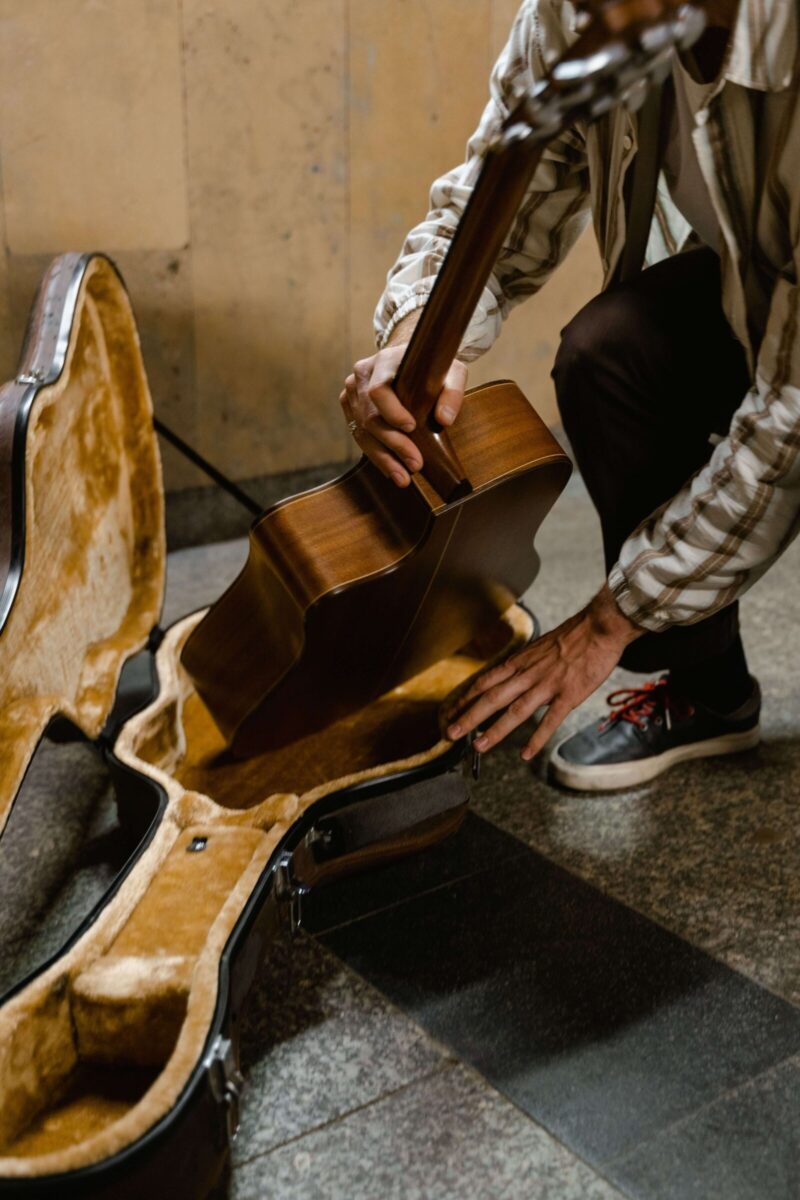
[00:00:00] Last week I was in Franklin, Tennessee. I was walking down the street, 95 degrees, super high humidity, and there was a really amazing singer sitting out on the town square. He was in the shade, but had a speaker and a guitar just singing perfectly out there, busking. We were just south of Nashville, so obviously singing a country song, and surprised that they were outside at all, because it was genuinely hot for mid-September in Tennessee.
If you've never been to Nashville, you really can't go very many places without hearing live music somewhere. Like, you can't walk down the street without hearing someone's voice. But it's usually in a restaurant or a club, it's often positioned as background music, so putting yourself front and center on the street is a different decision, and I think there's a lesson in that. Not a lot of people were stopping 'cause it was so hot outside, but that didn't stop him from going out and singing the song that was there to be [00:01:00] sung.
That type of putting your voice out there like that, busking, is a long time tradition for musicians. It's something my son has gone out and done with friends. He's been successful. I've never done it myself as a singer, but you see it in big cities like New York and Boston It takes a lot of confidence to go out there and perform without a guaranteed audience One of the most memorable times I witnessed this, this busking activity, was when we were in Ireland about a year and a half ago.
We went to Dublin, we were exploring the city, and we came across Grafton Street. It's one of those pedestrian-only, like, walkable shopping streets. It looked charming and European, so my family and I decided to go explore. But the shopping is not what Grafton Street is known for. It's known because it's where people have been busking and performing since it became a pedestrian-only street back in the 1980s.
Now, Ireland is a country of music and storytelling, and street performance has always been a big part of the culture, [00:02:00] even predating the, the pedestrian-only walkway that Grafton Street has become. But on Grafton Street, it's organized. It's a decision. You have to have a permit to go perform there. And every 100 yards or so, especially as the day went on and more shoppers were around, there were more and more musicians out there busking.
There were huge crowds around some of these singers and performers that were out there sharing their, their talents, and so many musicians come from all over Europe to build an audience and sing at all times of day. If you Google Grafton Street on YouTube, you'll see tons of videos of people out there busking, and you'll see not just musicians you've never heard of before, but people you have heard of, like Glen Hansard and Bono.
On Grafton Street, you get a w- hour in one place, and then you move along. It's a very organized way for people to find you, and I really love that, and it gives them a way to broadcast and say, "I'm going to be here at this time. Come listen." And you can build an audience. Now, all the music was different, all the performances were different, but the point was [00:03:00] they were deliberately sharing their signal, their voice, their music.
People were listening, but lots of people were walking by without paying attention at all. That might strike fear in your heart. It might sound scary. It takes true confidence to put yourself out there like that, and i- that's no different than when you're trying to share your ideas and your services with the world.
I think secretly we want people to come find us, these platforms we're building, and, and just magically show up and be an audience for us. We want the comfort of broadcasting to faceless strangers and having them magically engage and magically buy. But all of this work that we do as thought leaders, people with thoughts who step into visibility and lead others, it's all about building trust and building relationships with people.
And having the courage to show up and share in a situation where people can actively pay attention or walk away sounds terrifying. But I think it's a remarkably efficient way to test the resonance of the signal we're sending out for the audience [00:04:00] we want to attract. Business is never an if you build it, they will come situation.
We wish it was, but it's not. And especially when you're the face of your business, it's really not, and I think it feels a little bit scarier because it's your face. You're not hiding behind a logo. You're not hiding behind A big company, it's you. And I'm not saying you always have to show up on social media and share.
There are lots of places and spaces you can show up and build relationships with people, but you have to show up, and I think that's the hardest part. It can be hard to go into a sales conversation with confidence. It can be hard to share an idea you've never shared in a public forum. For me, both of those things are extraordinarily tricky.
Talking about myself in public has been tricky, which is very ironic considering it's what I teach people to do. I think for me, I'm anticipating rejection or, especially when it comes to sales, I don't wanna make someone feel uncomfortable about potentially saying no, so more often than not, I just don't say anything at [00:05:00] all.
So this busking analogy has been a helpful reminder to me that if I want to share my ideas that I believe are helpful, I need to make the deliberate decision to send my signal out, share my signal regardless, as well as encouraging other people to do the same So with all of this, I've been thinking a lot lately about how to grow an audience for your work, and it's been really instructive to watch my son building and working with the bands that he's part of.
Now, a few weeks ago, they had an opportunity to play as the opener for a pretty big local band at a local club where bands like Neon Trees and Imagine Dragons got their start. A lot of other nationally known bands have started at this club, so it's really fun to get the opportunity to play. My son's band was opening, and both his band and the headliner spent a lot of time and energy trying to drum up interest and invite people to come to the show.
They were on social media. They [00:06:00] were sharing reels. They were talking to people. They were putting up signs. They were texting people. They were doing everything they could to invite people to show up at this show at this one time in this specific place to hear what they'd prepared. And on the day, they had a good crowd.
It worked. A lot of energy, but it was a one-time event. And I think sometimes marketing and content can feel like that, and that can feel exhausting for people. It takes a lot of energy to convince people to show up at a specific time and a specific place, and I think for me, personally, that galvanizing energy is very difficult.
Getting people to do something they weren't planning on doing feels like a big ask for me to make. Galvanizing is one of my frustrations on Working Genius, and that's not an excuse, but it's just an opportunity to take a step back and go, "Oh, this is already hard, but it feels very draining for me specifically."
Rallying someone, especially that's a stranger, on the spot can feel discouraging Now I talk a lot about resonance and your signal being the [00:07:00] way that truth travels to other people. That signal has to be received by someone, and if you feel like you're forcing someone to receive that signal, it doesn't feel great.
Or when you're forcing yourself in different ways to send that out, that doesn't feel great either. Now, my son has done the big show and invited people at this specific time, but he's also spent time busking, and the thing he loves about it... First of all, he chooses and can't usually do it on his own with his full drum set, 'cause he's a drummer.
He has a bass player and a keyboardist with him or a, or a saxophone player, and they have a lot of fun just experimenting and playing and seeing what they can do. Gives them a, a ton of energy when people stop and listen. They're even more delighted, 'cause they're college students, so when they make money they get a little, you know, a, a few coins or dollars thrown into the guitar case or someone scans their Venmo and gives them some money.
But I think the thing that's been really fascinating to watch is it gives them such good data on what people want [00:08:00] to listen to, what music they love, what they care about, and they're able to take that data into their shows and create a better experience for the audience that is showing up So all of this has got me thinking, what if to complement the invitations to come to a specific thing at a specific time, I also just show up and share?
I think a planned performance is great, but a show like that doesn't always give you the data you need about growth, because everyone that was in the crowd at a planned performance chose to be there. That's awesome. It makes us feel great, makes us feel celebrated, and we know that that audience is ours, that audience of people who can buy what we're selling, amplify what we're doing, or both.
But they love what you're doing, and if you're looking for feedback on how to grow beyond that room, you might not get the right signal you need coming back to you to make decisions. It's like your mom telling you that you're, are really great at what you do. You kind of aren't sure if [00:09:00] that's the feedback you need to get in front of a different room.
But busking leaves no room for wondering about that. You're going to have people that just walk by and don't even notice. You'll have people that'll stop and politely listen for a second, and then they'll move on. And then you'll have people who stay and listen, and maybe they pay you, maybe they, like, Venmo you, drop a dollar bill, maybe they don't.
But if you have a system for following up with them, like the buskers that are on Grafton Street, where they say, "I'm gonna be at this place at this time sharing my music," maybe they do come back. Maybe they start to build a relationship with you. Maybe they do end up buying from you at some point. To me, busking is like a visual representation of how a sound wave works anyway.
It bounces off a hard object when you send a signal out. Like, maybe it bounces off a wall. It gets absorbed by a soft object, or it meets something that's free to move, and that vibration that you're sending out moves them, too. And that's when we use those music words to say, [00:10:00] "Man, I feel the truth of what you shared.
Let me engage a little bit further." They move. So when you give yourself permission to have enough courage to go out and test and share your voice, man, you get data. You see who stops. You see who listens. You see who pays. You see who engages further when you invite them. And the thing that's great about being in that situation, you can ask yourself different questions.
You can ask yourself about the kind of things you're sharing. You can ask yourself if, like, "Man, nobody's stopping. Maybe I'm on the wrong corner. Let me test this corner again and then maybe switch to a different spot." None of those questions are about whether or not your music is any good. Or your ideas are any good, to keep the analogy going, if you compare that to a planned show, if you have 100 seats to sell and you only sell 50, for some people that might feel exciting.
They had 50 people that they get to share with, and, and teach, and they get to learn from them, and have an experience [00:11:00] with them. Amazing, 50 people that I didn't have in the room before. But for most of us, we don't look at the 50 people in the room, we look at the gap of the 50 empty seats, and it makes us feel like a failure.
That's the wrong data to pull from that situation, in my opinion. But it's usually the story we end up telling ourselves, and that's the kind of story, that's the kind of data that can stop us from sharing anything at all It takes real confidence to share your ideas, to sell your ideas. That's why I think thought leader is the term that we use to describe this situation. I have thoughts, and I wanna lead with them. I wanna lead others well. I wanna share what I know. Putting yourself out there to do that takes confidence.
But confidence isn't a magical thing that someone, like, bestows upon you. It is built one day at a time by showing up with courage and taking action, and then confidence is the [00:12:00] byproduct. So if you look at somebody that's really confident, they weren't born that way. They took courageous steps and built that muscle, and in a weird way, I think busking inspires that courage and that confidence.
You have no other choice but to go out there and share the thing that you're the sh- that's yours to share, sing the song that's yours to sing. And the payoff for that is that the confidence that you gain in your own unique voice and impact is truly irreplaceable. And if you can do it repeatedly, that confidence grows swiftly, especially if you know what you have to share.
What you being you in public is valuable, man, there's nothing like it. There's a story that I tell, , quite often to clients when courage and confidence comes up. I saw a video a couple years ago of Chappell Roan. She's a pop star, if you've never heard of her. Has a very popular song a few years ago, , called Pink Pony Club, and this video I saw [00:13:00] was Chappell singing, busking out in public.
Nobody was really around. There were a few people there 'cause you could kind of hear them talking next to the person that was videoing her. But she was there with just a portable keyboard playing and singing her song, Pink Pony Club. Singing it with confidence, singing it, performing it, and, you know, this person was capturing it on video, like a lot of the people I saw on Grafton Street capturing these buskers on video.
But then the video I was watching cut to a different performance of that same song. This time, it was a show, and that show was Austin City Limits, which is an outdoor festival in Austin. Hundreds of thousands of people there in Zilker Park jumping, dancing, singing along to the exact same song You don't get gifted the stage sometimes without the courage to show up and share when nobody...
when it feels like nobody's listening, nobody's stopping, nobody's [00:14:00] watching. That takes courage, and that takes confidence in who you are, and singing the song that's yours to sing, and sharing the thing that's yours to share. There are people that are gonna stop, and they're gonna listen, and they're gonna wanna hear more, and you can give them a way to step in and learn more and follow along.
That's, that's a way to build an audience. That's a way to build courage and confidence and an audience at the same time. I don't think it's the only activity you should be doing, but if you're not thinking of your content, thinking of your opportunities to work with you as invitations, as just showing up and sharing and seeing what happens, you might be missing an opportunity to not only build your audience but build your confidence.
So for me, here's where I am. I've been running a free workshop every week for a couple of months now. It's been working reasonably well, and I think it might be time for me to test something else. I'm not sure what that is yet. I know that it always needs to involve time and a place for me to have a [00:15:00] conversation, to solve problems.
And so the version of that I'm testing now, in addition to workshops, is LinkedIn as a platform to build relationships, to reach out to people, I might not know yet, and then deliberately reaching out to people I do know who have come by and who have listened but maybe haven't been invited back. So I'm gonna be reaching out and inviting them to reengage
When I'm thinking about how to take my content, my, quote-unquote, "show" to people, I think about how I can be in a room, solve a problem, have a conversation. That's what the archetype assessment tells me. How can I spend as much time as possible and serve them and solve a problem? So taking a look at your assessment results and seeing what they say about you can give you some clues about what that looks like for you.
I think showing up busking one spot at a specific time every week is great 'cause people know where to find you if they wanna come hear you. That's the, the gift of the permits on Grafton Street, right? You know you were gonna be there 'cause you paid to be there. But showing up in different places and spaces and providing value is also [00:16:00] great.
I don't want you to hear this and think I'm telling you to show up in all the places all the time. I would never say that. You need to take the data you have to make deliberate decisions about where your voice is going to ring the best. Now, that singer in Franklin was still singing when I walked away, and he was still singing later that day when I walked back to my hotel.
He'd made his decision about where his voice was best, and he, on that day, kept making that decision all afternoon So here's what I'd love for you to think about. What's one place where you could show up and share, where people are free to stop and pay attention or potentially walk by? What could that kind of data help you figure out about your content, your ideas, your offer?
It's great to have those specific places we're inviting people to show up, but we can also show up. We can build our own platforms. We can build our own spaces. We can busk on a street corner and share our voice and see what happens Now, if you've been standing on the sidewalk listening to [00:17:00] this show of mine for a while, I wanna practice what I preach and issue an invitation to step in further.
The Resonance Conservatory is open until October 7th. That's when we start for the fall. If you've listened to this, if you've taken the assessment, if you've recognized more about your unique voice, your unique way of delivering value, if you've come to one of my workshops or listened to a lot of podcast episodes to explore these ideas a little bit more, that's great.
And the conservatory is where you make the actual commitment to be the face of your business, to be the voice, to calibrate the signal you're sending, and lean into the gap that's specifically yours to fill. We map out, we uncover your specific way of sharing, showing up, providing value, and then we walk through the decisions that you have to make as the face of your business about what to do with that signal, what you teach, what you sell, how you deliberately invite people to start building a relationship with you and connect with them.
What are the spaces and places that are [00:18:00] specifically best for you to show up and build relationships, to create and sell offers, and provide value with your ideas and your leadership and your specific voice? We just finished the summer cohort of the conservatory, and one of my clients, Carolina, said this about her experience.
She said, "My hesitation was that I wasn't far enough along in building my business, my IP, my offers." I'm gonna pause her testimonial right here and just say she's brilliant. She's been behind the scenes of some massive platforms and has provided immense amounts of value, and I was thrilled that she decided to make the commitment to step in.
I'm going on with her voice now. Here's what she said. She was worried she wasn't far enough along. She said, "It turned out to be perfectly timed, and I never once felt behind or out of place in the cohort. Time and confidence were the two things standing in my way, and Macy gave me practical ways past both.
What I came out with wasn't a list of things I should do. It was a roadmap that kept [00:19:00] pointing at things I already had and telling me to use them." If that sounds like you, I would love to have you join us
And if you wanna do a little bit more exploration beyond listening to the podcast, there's one more scheduled opportunity to join my free workshop next week where you can get your expanded results just by spending the hour with me. It's on Tuesday, September 29th at 9:00 AM Mountain Time, and you can sign up at macyrobison.com/workshop.
Thank you for listening. Come back next week for more encouragement on how to cultivate the voice that is uniquely yours, as unique as your fingerprint. And until then, I hope to run into you busking somewhere on these online streets








+ show Comments
- Hide Comments
add a comment